

Key Takeaways
- Knowledge bases plateau at 20%-40% deflection because they can't solve investigation-based tickets that require ongoing operational oversight.
- The real self-service gap occurs post-submission when teams lose access to comprehensive operational data like detailed SLA metrics, custom fields, and exportable reports.
- Operational transparency reduces agent interruptions for manual reporting while empowering teams with the data-driven insights they need for effective service management.
- Advanced Portal Reports bridges this gap by providing customizable reporting, advanced filtering, and comprehensive operational visibility directly through the JSM portal.
You've Hit the Knowledge Base Plateau (And That's Normal)
You've invested time and resources into building a knowledge base. It deflects tickets and reduces agent workload, but portal users still submit tickets, and inefficiencies persist. Why?
Because knowledge alone doesn't deliver complete self-service. Without comprehensive visibility into the operational details that matter, portal users and their teams lack the transparency needed for true efficiency.
Your Jira Service Management (JSM) knowledge base achieves 20%–40% case deflection, which is a solid win. But if you're reading this, adding more articles isn't moving the needle on operational efficiency and team productivity anymore.
The problem isn't with deflection, it's with what happens after users submit the tickets that can't be deflected.
Why Knowledge Bases Hit a Natural Ceiling
There’s no doubt that knowledge bases excel at documented, repeatable solutions. Password reset procedures work beautifully. Common software troubleshooting? Perfect fit. Standard request processes get handled smoothly through self-service articles.
But here's where your self-service breaks down: knowledge bases fail spectacularly when users need nuanced, contextual help. Consider these real scenarios that can't be solved with a generic article:
- "My VPN works on WiFi but not ethernet"
- "I can access SharePoint but not Teams with my new laptop"
- "The password reset email never arrived, and I've checked spam"
These situations require investigation, not instruction. Once portal users encounter problems that demand human expertise and troubleshooting, your carefully crafted knowledge base becomes irrelevant.
The fundamental limitation is that many JSM tickets require analysis of specific configurations, unique user setups, or environmental factors that no article can anticipate.
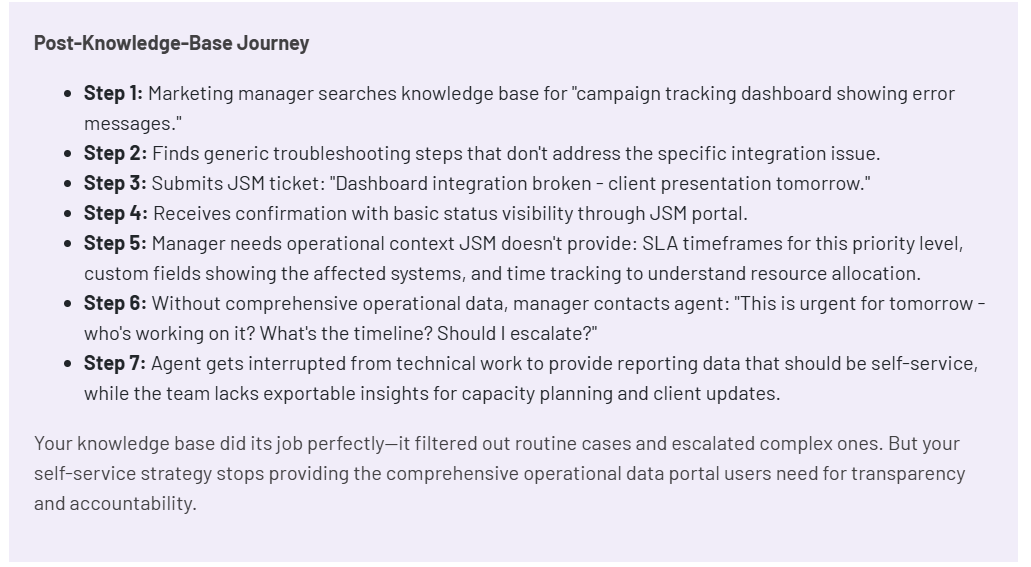
This is where your self-service strategy hits its ceiling. Knowledge bases provide information brilliantly, but complex issues need investigation.
And once portal users submit those tickets? They lose access to the rich operational data required for effective self-service management and reporting.
Why Operational Transparency Matters More Than More KB Articles
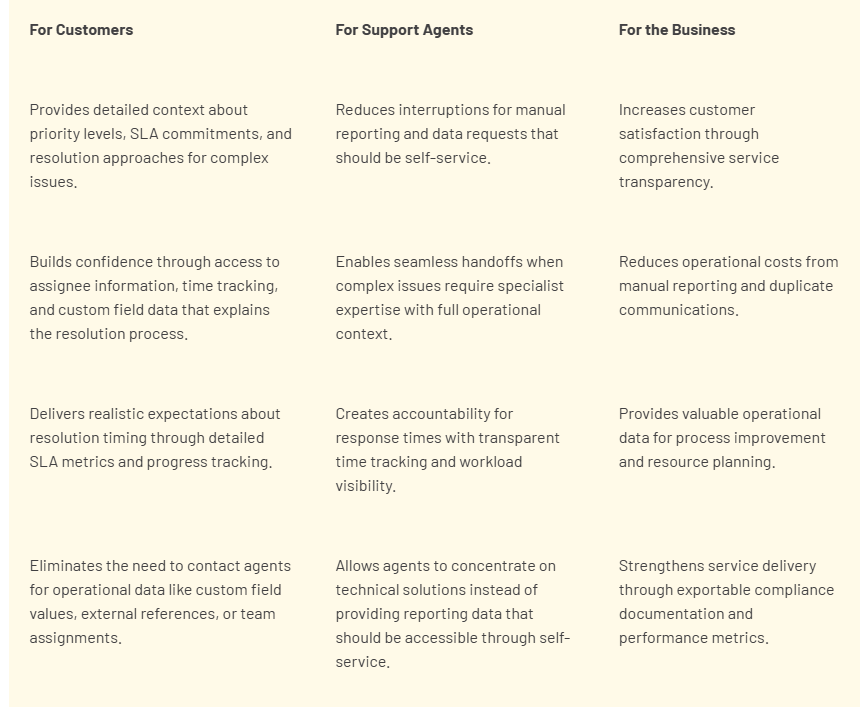
JSM admins often think the solution is better content when the real problem is post-submission operational visibility. Teams need comprehensive data access because:
The Missing Layer Your KB Strategy Needs
While your JSM knowledge base handles deflection brilliantly, Advanced Portal Reports completes the picture by adding comprehensive operational transparency. Here's what our app adds to your existing knowledge base investment:
Comprehensive SLA for Performance Visibility
Unlike routine KB-solvable issues, investigations require detailed performance tracking. Advanced Portal Reports provides teams with granular SLA metrics, time remaining calculations, and performance data that standard JSM portals don't expose, enabling proactive management of complex cases.
This kind of operational transparency transforms the entire post-submission experience, empowering users with the comprehensive real-time insights they need for effective service management.
Smart Search for Faster Resolution
Portal users and agents can locate tickets using business-specific identifiers like customer IDs, project codes, or external reference numbers while filtering across multiple custom fields simultaneously. This enables teams to track requests across complex organizational structures with precision.
For example, a call center agent supporting hotel reservations can instantly filter by booking ID, support plan type, and priority level to locate a customer's request within seconds, while also viewing related tickets across their account portfolio.
Customizable Reports for Data-Driven Decisions
Teams can create tailored reports showing ticket volumes, detailed SLA performance metrics, time tracking data, custom field analysis, and resolution trends without depending on agents.
These reports (e.g., Created vs Resolved chart) provide managers with departmental insights and clients with comprehensive compliance documentation.
Portfolio Views for Team Management
While knowledge bases help individuals solve problems, Advanced Portal Reports enables managers to monitor entire ticket portfolios with customizable field visibility, track overdue items across multiple SLA types, and maintain oversight across complex client accounts or departmental requests.
Rich Operational Context
Advanced Portal Reports reveals critical operational data (custom priority classifications, support entitlement details, platform specifications, detailed assignee workloads, external system references) that remains hidden in standard JSM portals, giving teams complete operational context for their requests.
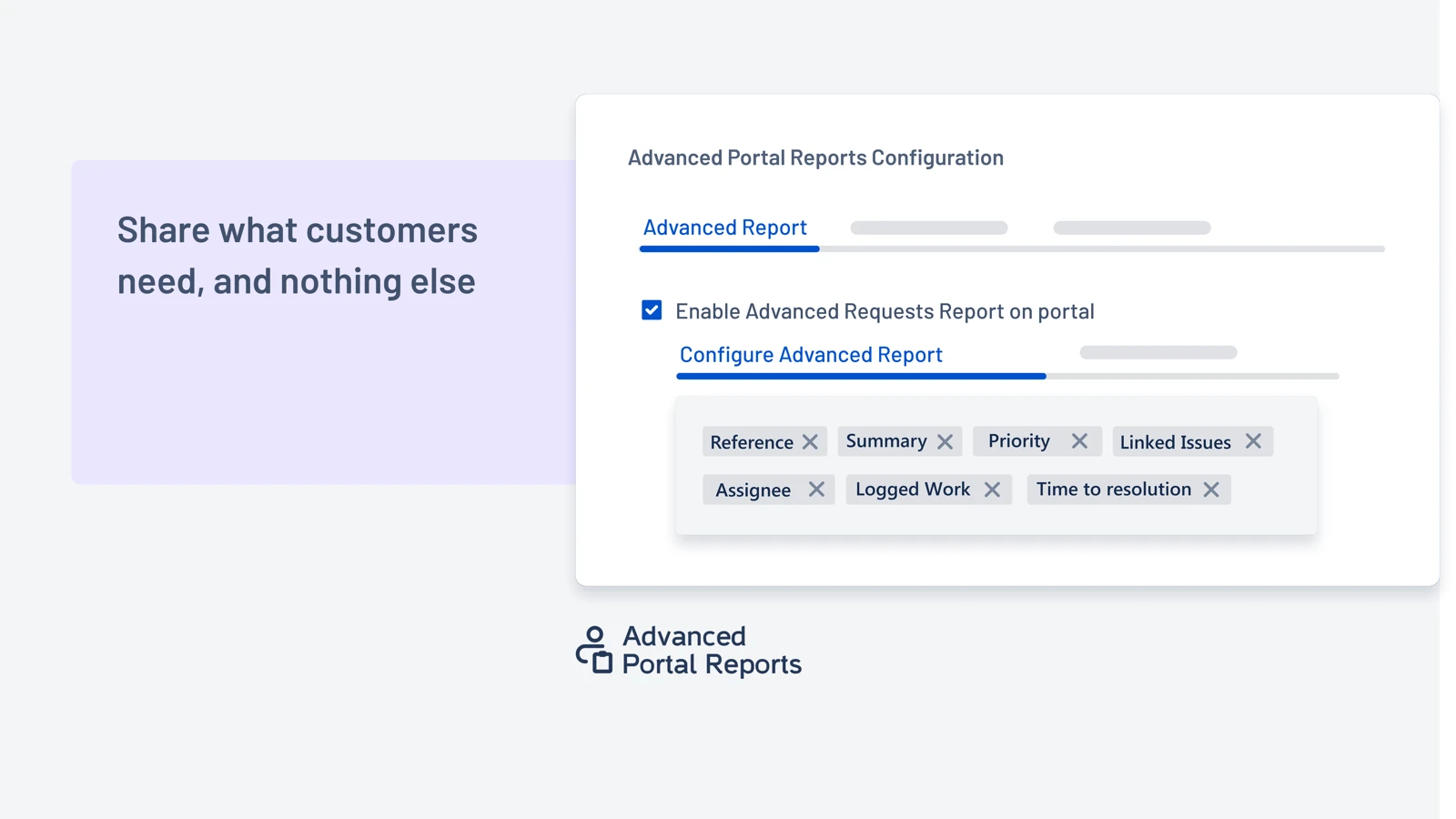
This eliminates confusion about service entitlements, reduces back-and-forth communications for operational details, and provides the comprehensive transparency teams need for effective self-service.
Reduce Licensing Costs Through Portal-Only Access
Organizations can provide comprehensive operational reporting capabilities to business stakeholders through enhanced portal access, reducing expensive Jira licensing costs while maintaining full functionality for request tracking, analysis, and reporting.
Instead of purchasing additional Jira licenses for project managers who need to monitor IT feature requests and track delivery metrics, they can access everything they need through the portal with global views, custom field visibility, and export capabilities.
Advanced Portal Reports doesn't replace your knowledge base, it ensures that when portal users do need to submit requests, they have comprehensive operational visibility throughout the resolution process, making your entire support ecosystem more efficient and data-driven.
Bridge the Gap: From Knowledge Base to Complete Self-Service
Your knowledge base investment was smart and continues delivering value. But complete self-service extends beyond deflection to include comprehensive operational transparency for the cases that require human expertise.
Transform your JSM from a deflection-focused portal into a complete self-service operational hub where teams have full visibility over the rich data that drives effective service management, whether their issue needs an article or an investigation.
With this approach, teams trust your self-service process for both simple and complex issues because they have access to the operational insights they need. Agents focus on problem-solving instead of manual reporting tasks, and your knowledge base deflection rates improve.
Ready to complete your self-service strategy? Discover the complete framework for operational transparency in our Complete Guide to Self-Service in ITSM (And the Missing Last Mile) or download our ebook today.


